How to Plan a Software Development Budget Without Getting Burned
Business See our pricingSoftware development projects go over budget for three predictable reasons: the scope was not defined precisely enough, the estimate did not account for the full delivery chain (infrastructure, testing, onboarding), or requirements changed without a formal cost impact discussion. All three are preventable with the right process before the project starts.
Start with a clear scope document — not a wish list
The most expensive words in software projects are "I assumed that was included." Before requesting any quote, write down, in plain language, what the software must do. Not how it will work technically — what it will do. Describe each user role, the critical workflows they follow, and the data that flows between them. This document becomes the contractual scope that protects you from scope creep and protects the vendor from underbidding.
A good scope document is 5 to 15 pages, not 50. It describes what is in scope and explicitly calls out what is not. If you cannot write it without the vendor's help, budget for a paid discovery phase before committing to a full build price.
Understand what you are actually paying for
A quoted development cost typically covers engineering time. It may not cover: cloud infrastructure (AWS/GCP hosting, databases, storage), third-party API licences (SMS gateways, maps, payment processors), UI/UX design if the quote is code-only, QA and testing beyond developer unit tests, data migration from your current system, user training and documentation, and ongoing support and updates post-launch.
Ask any vendor for a fully-loaded project cost that includes all of the above. If they cannot provide it, price each line item separately so you know the true number before signing anything.
Fixed price vs time and materials
Fixed-price contracts are appropriate when your requirements are stable and well-documented. They give you certainty but transfer flexibility risk to the vendor, who will build exactly what the spec says — no more — and raise change orders for anything outside it. If you discover mid-project that you need a different feature set, you pay a change premium.
Time-and-materials (T&M) contracts are appropriate when requirements will evolve — typical of innovative products or internal tools being built iteratively with user feedback. You pay for actual hours, with agreed-upon weekly or monthly cap reviews. This gives you flexibility but requires disciplined scope management on your side.
A practical hybrid: fixed price for a two to four-week discovery and specification phase, then T&M for development sprints with a monthly budget ceiling. This gives you a real estimate based on a real spec, not a ballpark from a 30-minute call.
The 20 percent contingency rule
Add 20 percent to any project estimate before you budget for it. Not because vendors underquote dishonestly — most don't — but because complex systems always reveal integration edge cases, data quality issues, or UX refinements that weren't apparent in the specification. Teams that budget with zero contingency end up negotiating mid-project, which degrades both quality and the vendor relationship.
What good software costs in India in 2026
As a rough reference, from quality teams in Pune or Bengaluru: a marketing website with CMS costs ₹1.5 to 4 lakh. A mobile app MVP (one platform) costs ₹6 to 18 lakh. A custom CRM or SaaS portal costs ₹10 to 35 lakh. Enterprise systems with complex integrations start at ₹40 lakh and scale with scope. Offshore teams quoting dramatically below these ranges typically signal risk in delivery capability, quality standards, or post-delivery support. The figures we actually quote are in our published price bands.
How TechLapse structures pricing
We offer a paid discovery phase for projects above ₹8 lakh — two to four weeks of scoping, architecture, and prototyping that produces a binding specification and a firm fixed-price or monthly T&M quote. This protects both parties. Explore our pricing page or request a project estimate from our Pune team.
Frequently asked questions
How much does custom software development cost in India?
A focused MVP from a Pune-based quality team typically ranges ₹5 to 25 lakh. Full enterprise systems can run ₹40 lakh and above. Per-hour rates from experienced teams range ₹2,500 to ₹6,000.
What is scope creep and how do I prevent it?
Scope creep is gradual requirement expansion without budget/timeline adjustment. Prevent it with a detailed written specification, a formal change request process with cost estimates, and weekly scope reviews.
Fixed price or time and materials — which is better?
Fixed price suits stable, well-defined requirements. T&M suits iterative, exploratory projects. The best hybrid: fixed price for discovery, T&M for development with monthly budget reviews.
TechLapse provides transparent, scope-based pricing for custom software in Pune. Request a project estimate — no commitment required.
Back to blogRelated articles
-
How to Choose the Right Tech Stack for Your Project
Framework for evaluating web, mobile, and backend choices.
-
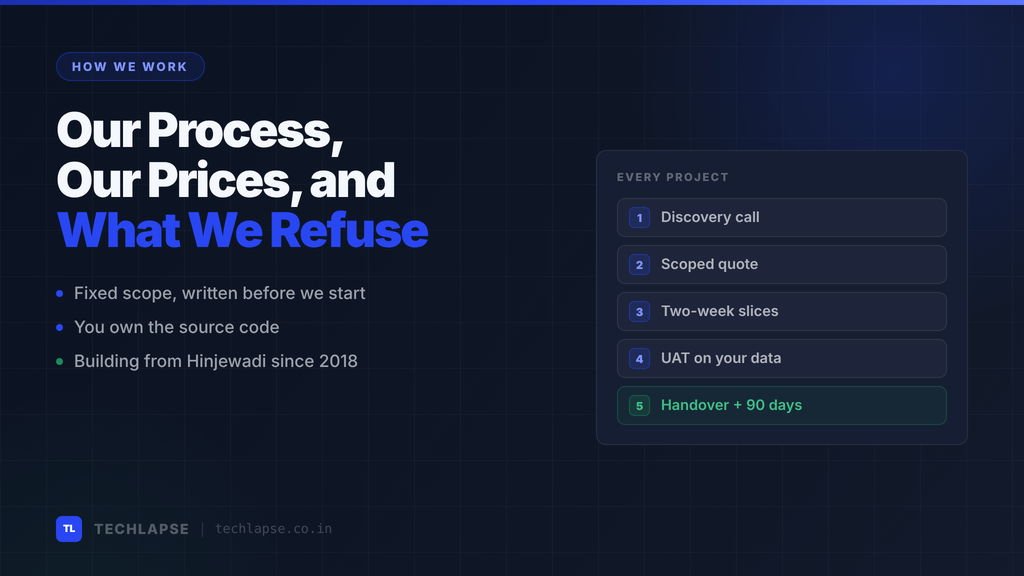 How TechLapse Works: Our Process, Prices and Refusals
The five stages, the three price bands, and the work we turn down.
-
