Why Custom Software Is the Right Fit for Your Business
Software Custom softwareSummary
Custom software is a fit, not an upgrade. Four signals decide it: the process is the edge, the workaround has become the job, seat cost has caught the build, and you must own the data. Miss them and you pay to rebuild something Zoho already does.
The pitch I hear before the first call is almost always the same. Our software is holding us back. We should build our own.
A distributor in Pimpri, still on Zoho, with a rate card that no standard product will store. A clinic in Kothrud whose appointment book is fine and whose lab slips are not. A plant in Chakan running Tally for accounts and a shared spreadsheet for the jobs Tally was never meant to track. Someone has told each of them that growing up means a custom platform.
Sometimes that is true. Often it is a rebuild of a tool that was already doing its job. Custom software is not a better Zoho. It is the piece Zoho will not become, and only when that piece is how you actually make money. We start by trying to talk you out of the build. The custom versus off-the-shelf comparison is the long version of that argument. This page is the test we use on the call.
Off-the-shelf comes first
Zoho, Tally, a spreadsheet, the appointment system you already paid for. Those are the default. They are cheap to start, someone else maintains them, and your CA already knows the export. Replacing one because a demo looked cleaner is how a six-month project begins and a GST deadline gets missed in the middle of it.
I ask what the current tool refuses to do, not what the team dislikes about the colour of the screen. A missing report that the vendor will add next quarter is not a reason to build. A rule that is the reason customers stay, and that no vendor will put on a roadmap because only you run it that way, is a reason. If we cannot name that rule in one sentence, we are not ready to write a proposal.
The expensive failure is a custom copy of a commodity. Email, basic accounting, a standard CRM pipeline. Those stay where they are. The build, if there is one, sits beside them and talks to them. A giant replacement of something Zoho already does well is the outcome we are trying to avoid.
The four signals
On the fit call we score four things. All four, and a custom system pays for itself. One, and you should stay. Two or three, and we build the module that hurts and leave the rest of the stack alone.
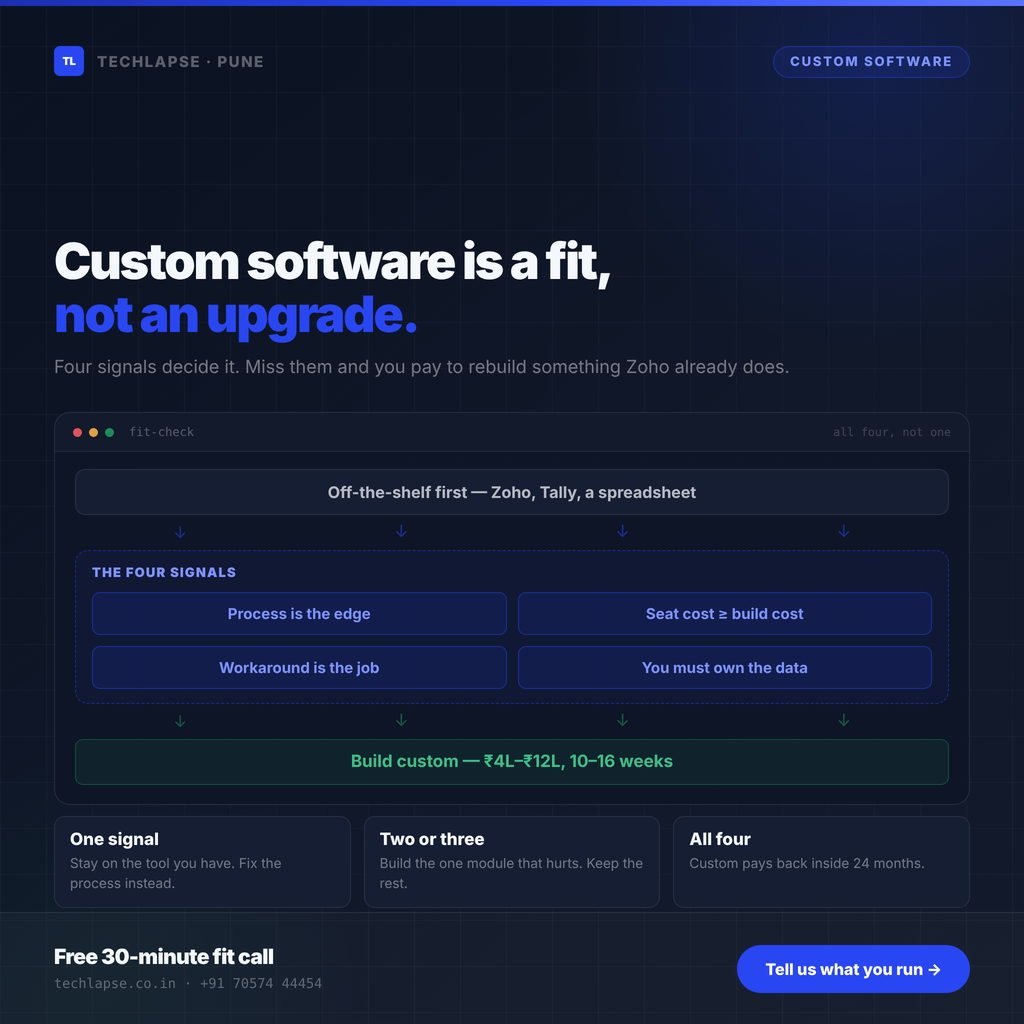
The process is the edge
Your way of taking an order, routing a job, or pricing a contract is why the customer calls you and not the next name on Indiamart. If a standard product can express that process with its own fields, the process is not an edge. It is a configuration. If staff keep a second record because the product flattens the thing that makes you different, the process is the product. That is the first signal.
A freight desk in Nagpur priced a trip from lane, detention and a relationship the customer would not put in an email. The TMS they trialled had lanes. It did not have the relationship. They went back to WhatsApp. The edge was real. The software they almost bought was a brochure of someone else’s edge.
The workaround became the job
Every company has a spreadsheet beside the real system. Most of them are harmless. The signal trips when the spreadsheet is no longer a backup. It is the place the number is born, and the official system is where someone types it on Friday so the accounts will match.
I look at who opens the file, how often, and what happens if it is wrong. If a missed row delays a dispatch, a lab report or a vendor payment, the workaround is the job. Building a screen for that job is the project. Rebuilding the accounting package around it is not.
Seat cost has caught the build
Per-seat pricing is honest until the seats are people who only need one screen. Twenty-five users at ₹1,500 a month is ₹4.5 lakh a year before add-ons, and by year three you have spent more than a focused build without owning the workflow that matters. That arithmetic is a signal. It is not, by itself, a reason to start.
If the tool fits and the seats are people who use it all day, pay the seats. The comparison that matters is seat cost against the hours the workaround burns, not seat cost against a vanity rebuild. We write both numbers down before anyone talks about a platform.
You have to own the data
Some businesses can live in a vendor’s cloud. Some cannot. A clinic that has to answer a DPDP request, a manufacturer whose customer contract says the production history stays in India, a firm that will not have its pipeline locked to a login it does not control. Ownership here means the database, the export, and the right to leave.
Owning the logo on a login screen is not the same thing. If the vendor already gives you a full export and a contract you can live with, this signal is false. We do not build a second database so that a slide can say “your data, your servers.”
One signal, or all four
One signal means stay. Fix the process, or pay the vendor to add the field, or hire an operator who will actually fill the one you have. A custom build on a single complaint is how you end up maintaining a worse Zoho.
Two or three signals mean a module. The rate card, the job card, the lab slip, the trip sheet. It reads and writes the system you already run. The people who raise an invoice still raise it where they did last Tuesday. This is the shape of most of the work we take.
All four, and the custom system is the business. A full operational build in that case sits in a band of ₹4 lakh to ₹12 lakh and usually ten to sixteen weeks, phased so the first workflow is in use before the last one is designed. Payback inside twenty-four months is the claim we will write down only when the hours you lose today are real. If we cannot point at those hours, we will not put the sentence in a proposal.
What we still refuse
A rebuild of Tally. A CRM whose only fault is that the team will not type notes. A fixed price before the workflow is written. A codebase you are not allowed to take with you. An AI feature sprinkled on a process that is still a notebook. If the software you have can already do the job, the way we run a project starts by saying so.
The fit call is thirty minutes. You leave with a note: which signals fired, what we would leave on Zoho or Tally, what a first module would touch, and a range. Take it to another vendor if you want. The point of the note is that the decision is visible, not that the next step is always a build. When it is a build, it is scoped as custom software, with a written range and a phase you can stop.
Frequently asked questions
When is custom software the wrong choice?
When only one of the four signals is true. A standard process on Zoho or Tally does not improve because you paid to rebuild it. Fix the process, or the one field the tool will not store, and leave the rest alone.
How much does a custom build cost in India?
One workflow that replaces a spreadsheet is usually ₹1.5 lakh to ₹4 lakh. A full operational system, the case where all four signals are true, is typically ₹4 lakh to ₹12 lakh and ten to sixteen weeks.
Can we keep Zoho and build only the missing piece?
Yes. That is the usual outcome when two or three signals are true. We build the module that hurts and leave accounting, email and the CRM you already trust exactly where they are.
Who owns the software after we go live?
You do. The source code, the repository and the data move to you on handover. We do not keep a licence that lets us switch the system off if you later change vendors.
Book a 30-minute fit call
Tell us what you run today. We will say which of the four signals are actually true, and we will say no if Zoho already does the job. Call +91 70574 44454, or write it down on the contact page.
Book the fit call Custom softwareRelated articles
-
 Custom Software vs Off-the-Shelf
When a rebuild is the right call, and when the software you have is enough.
-
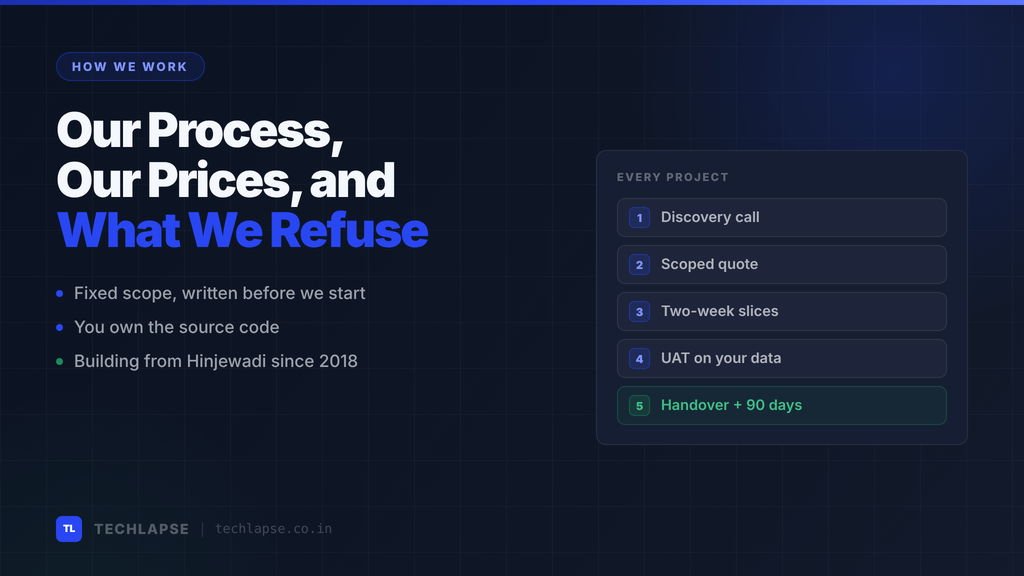 How TechLapse Works: Our Process, Prices and Refusals
The five stages, the three price bands, and the work we turn down on call one.
-
Need a clear quote?
Tell us what you are building — we reply within one business day.
Free consultation