How TechLapse Works: Our Process, Prices and Refusals
Business Custom softwareSummary
Every TechLapse project runs the same five stages: a discovery call, a scoped quote, two-week slices, UAT on your data, and handover plus ninety days. The price is one of three bands. If an off-the-shelf tool fits, we say so before a proposal.
People ask what it costs before they ask what it is. I will not answer the first question until the second one has a written reply.
A founder in Hinjewadi wants a number on the call so he can compare three vendors by evening. A plant head in Pimpri has already been burned by a fixed price that did not include the Tally export. A clinic administrator wants to know if the people who build it will still answer the phone in March. The process below is how we answer all three without inventing a figure.
We have built from Hinjewadi since 2018. The stages have not changed because a new framework showed up. What changed is that we now publish the bands, and we publish the work we turn down. The rest of this page is that list.
The five stages
Same order, every time. A stage that gets skipped is the stage that shows up later as a surprise invoice.
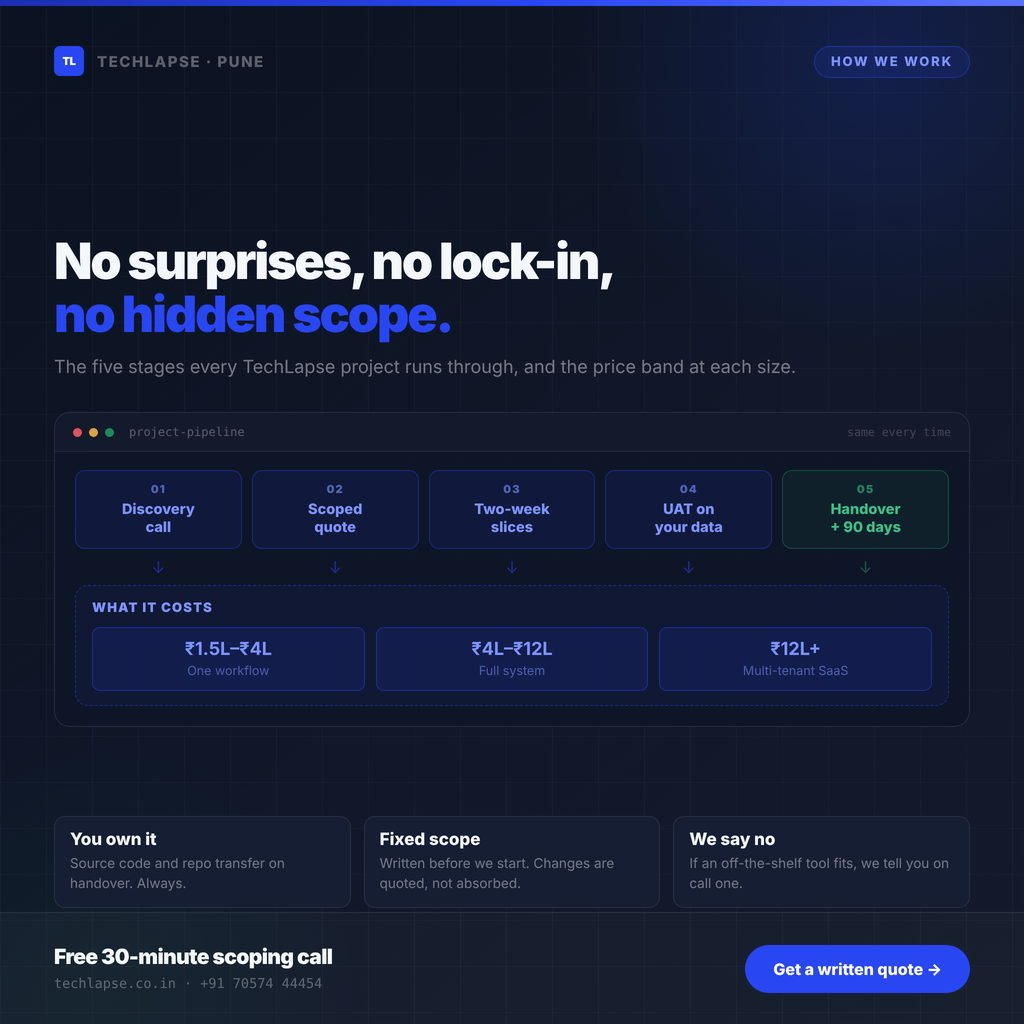
Discovery call
Thirty minutes. You describe what you run today and where the day actually breaks. We look for a system we can name, a person who feels the break, and a sample of the bad rows, not a slide of the happy path. You leave with a note. The note is allowed to say “do not build this.”
We do not quote in this meeting. A number given before the workflow is written is a number that moves, and the move is what people remember. If you need a ceiling to decide whether the conversation is even worth an hour, we will give a band and mark it as a band.
Scoped quote
The quote is a document, not a paragraph in WhatsApp. It names the workflow, the screens, what is out of scope, the systems we will talk to, and the range. Fixed scope is written before we start. A change after that is quoted. It is not absorbed to keep the relationship pleasant.
If you cannot yet say what done looks like, the scoped quote is the wrong instrument. We will say so and stop, or we will price a short discovery that produces the document. We will not pretend a thirty-minute call was a specification.
Two-week slices
The build is cut into slices you can reject. Every two weeks there is software on your data, or on a copy of it, that a person from your team can click. A slice that only a developer can demo does not count. The point of the cut is that you can stop. Stopping is a feature of the contract, not a failure of the project.
We do not disappear for three months and return with a reveal. The teams that hated their last vendor usually hated the silence, not the invoice.
UAT on your data
Acceptance happens on your orders, your patients, your trips. A demo tenant with twelve tidy rows will pass tests your Monday will not. We want the duplicate customer, the GSTIN that does not validate, the job card with a blank quantity. If those rows are not available, UAT has not started, and we will not call the slice done.
Handover and ninety days
You get the repository. The remote is yours, the history is yours, and a colleague who was not in the project can clone it. For ninety days we fix defects inside the scope we signed. A new report, a new role, a new integration are the next quote. The ninety days are not a retainer you accidentally bought.
Three price bands
These are the ranges we actually put in writing. They are not a rate card, and they move when the workflow is larger than the sentence that described it.
₹1.5 lakh to ₹4 lakh is one workflow. A screen the team already needed, talking to a system you already run: the job card, the rate exception, the lab slip. ₹4 lakh to ₹12 lakh is a full system for that team, several workflows, roles, and the reports the owner asks for on Monday. Above ₹12 lakh is a multi-tenant product, the case where you are building software you will sell or run for many sites. How to read a vendor’s number against a budget is the longer piece on planning a software budget. The bands here are simply ours.
A figure below the bottom of a band is a reason to ask what was left out, not a reason to celebrate. Hosting, a payment gateway, the time your own staff spend on UAT, and the ninety days are either inside the quote or listed next to it. If they are in neither place, the quote is not finished.
You own it
Source code and the repository transfer on handover. Always. We do not retain a licence that makes us a gatekeeper, and we do not host the only copy. Your data stays in the database you can export. If a project cannot be agreed on those terms, we do not start it.
Ownership is also why we will not build you a thin skin over a tool you rent per seat and then call it a product. If Zoho is the system of record, Zoho stays the system of record. We will build the piece beside it, the way we describe in when custom software is the right fit, and we will not pretend the piece is the whole company.
The work we turn down
Four refusals, said on the first call rather than in week six.
We will not rebuild a tool that already fits. Tally for accounts, a mature CRM for a standard pipeline, mail. If the complaint is taste, the answer is no. We will not sign a fixed price against a sentence. Scope is written first, or the engagement is a paid discovery that produces the scope. We will not build software you cannot take with you. And we will not bolt an AI layer onto a system we cannot reach: no API, no database, nothing but a scanned PDF. That last refusal is the same test as adding AI without a rebuild. A demo that answers anyway is not a project we will put our name on.
Saying no is part of the quote. A vendor who cannot name a job they would decline is selling capacity, not a result. When the note says yes, the next step is a written range under custom software, and a first slice you can stop after.
Frequently asked questions
Do you give a price on the first call?
No. The first call is discovery. You leave with a written note of what we would build and what we would refuse. The number comes after that scope is written down, not while we are still on the phone.
What do the three price bands cover?
₹1.5 lakh to ₹4 lakh is one workflow. ₹4 lakh to ₹12 lakh is a full system for the team that runs it. Above ₹12 lakh is a multi-tenant product. Each figure is a range, written before we start.
What kinds of work do you turn down?
A rebuild of something Zoho or Tally already does, a fixed price with no written scope, a project where you will not own the code, and an AI layer on a system we cannot reach. We say so on call one.
What happens in the ninety days after handover?
You receive the repository, and we fix defects that sit inside the scope we signed. New features after handover are quoted on their own. They are not absorbed into the original price.
Book a 30-minute scoping call
You leave with a written note, not a slide. If an off-the-shelf tool fits, we will say that on the call. Call +91 70574 44454, or tell us what you run on the contact page.
Get a written quote Custom softwareRelated articles
-
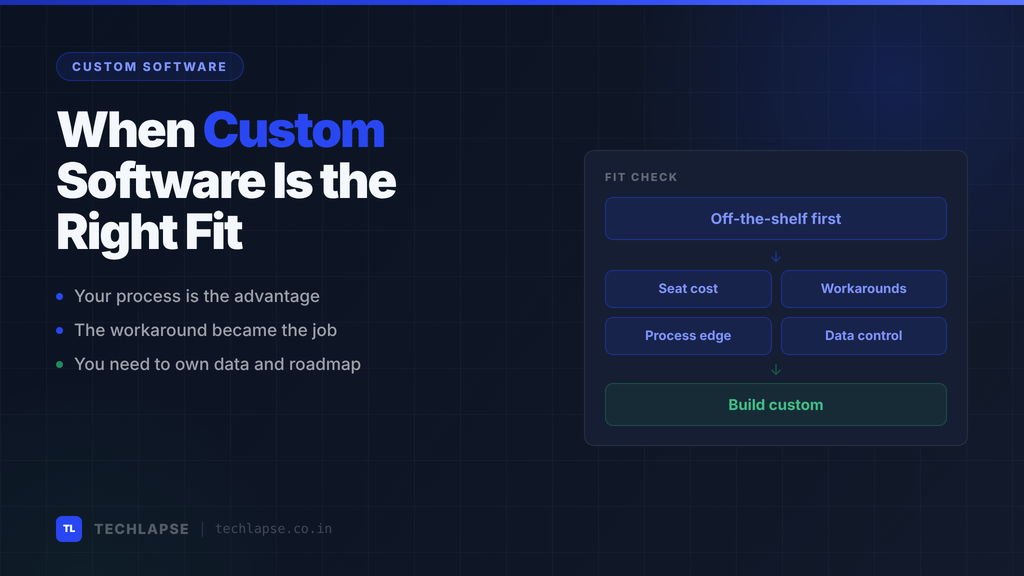 Why Custom Software Is the Right Fit for Your Business
Four signals decide whether to build or stay on Zoho.
-
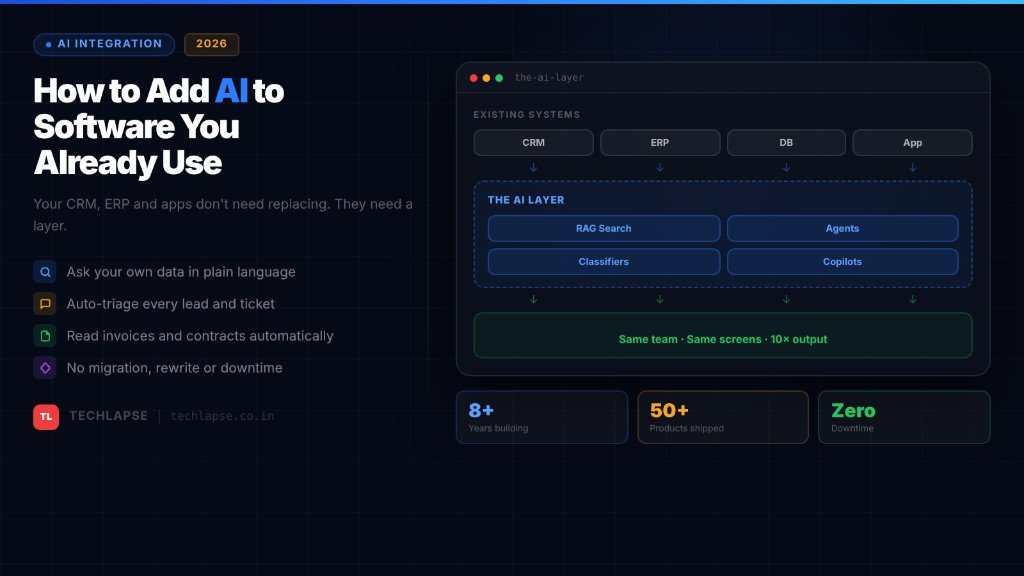 How We Add AI to Software You Already Use
A layer on the CRM or ERP you already run, with no migration and no downtime.
-
Need a clear quote?
Tell us what you are building — we reply within one business day.
Free consultation